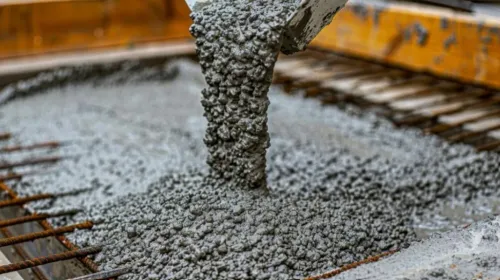
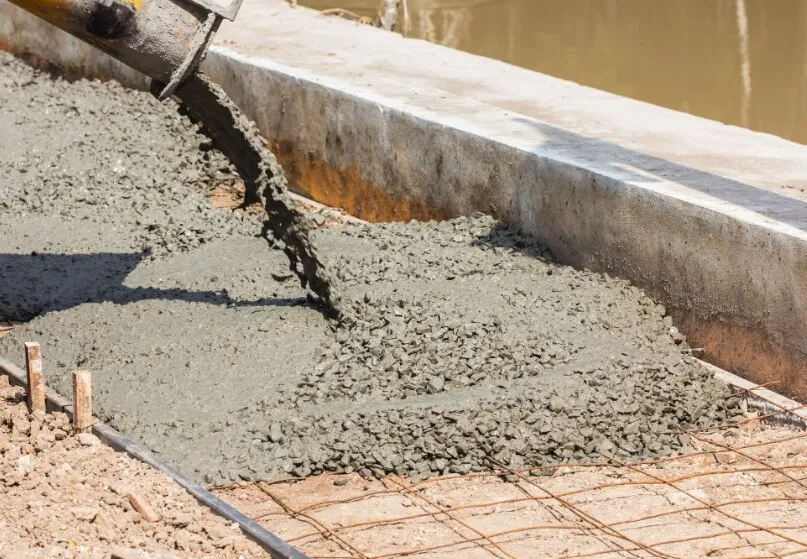
Heavy-duty concrete is not defined by a high M grade alone. You need to connect the structural design, exposure conditions, production controls, delivery plan and site execution so the concrete performs under the actual load, abrasion, vibration or chemical attack it will face.
Key takeaways
- Match strength, exposure class, abrasion, and service loads to the specification.
- Check mix designs, raw-material testing, batch records, and cube-test results.
- Control delivery time, concrete temperature, placement, compaction, and curing.
- Qualify manufacturers through plant audits, trial batches, and documented quality systems.
What qualifies as a heavy-duty concrete application?
An application qualifies as heavy-duty when concrete must resist high repeated loads, impact, abrasion, vibration, chemicals, or severe environmental exposure throughout its design life. Industrial floors, warehouse slabs, crane foundations, equipment bases, yards, retaining structures and bridge elements can all fall into this category, but their demands are not interchangeable.
Before choosing M30, M35, M40 or M45, identify what the concrete must withstand:
1. Read the structural drawings for the specified characteristic compressive strength, member size, reinforcement, joint layout and design life. The grade is a 28-day strength class in MPa, not a complete performance specification.
2. Define the load: static storage, moving forklifts, crane wheel loads, machine vibration, impact, bending, concentrated support reactions or repeated fatigue. A floor exposed to abrasion needs a different assessment from a pile cap carrying a heavy column.
3. Classify the exposure under IS 456:2000. Record whether the concrete faces moisture, chlorides, sulphates, carbonation, wastewater or industrial chemicals, then set limits for water-cement ratio, permeability and cementitious materials.
4. Specify performance beyond strength, including abrasion resistance, crack-width control, shrinkage, fire exposure and chemical resistance. A higher grade will not prevent dusting, curling or joint failure caused by poor floor execution.
5. Confirm placement constraints. Pumping distance, discharge slump, evaporation, finishing time, saw-cut timing and curing method affect the result.
Curing belongs in the requirement: state its start time, method, minimum duration and responsible party. Standard-cured cubes can pass while an inadequately cured surface loses strength, absorbs water and wears prematurely.
How should you select the concrete specification?
Read the structural drawings before choosing a grade. They state the characteristic strength in MPa, reinforcement, member size and design actions; the concrete supplier’s mix must meet those requirements, not replace them. M30 concrete, M35 concrete, M40 concrete and M45 concrete identify strength classes, but grade alone does not define durability or site performance.
| Grade | 28-day characteristic strength | What the label does not define |
|---|---|---|
| M30 concrete | 30 MPa | Exposure durability, workability or abrasion resistance |
| M35 concrete | 35 MPa | Permeability, shrinkage or chemical resistance |
| M40 concrete | 40 MPa | Crack control, temperature or service-life performance |
| M45 concrete | 45 MPa | Placement method or resistance to the actual deterioration mechanism |
Apply IS 456:2000 exposure class to set the durability baseline and maximum water-cement ratio. Then match the load type and design service life: repetitive wheel loads call for abrasion control, vibration-sensitive equipment may need crack and stiffness control, and wastewater or chloride exposure may require permeability, sorptivity or chloride testing beyond cube strength.
Write the procurement specification with the grade plus the maximum water-cement ratio, cementitious-material limits, aggregate size, slump at discharge, chloride and temperature limits, admixture dosage and curing obligations. Confirm the 28-day strength through the specified testing plan; a high M grade cannot compensate for unsuitable exposure limits, poor placement or inadequate curing.
Which production controls make each batch dependable?
A dependable batch starts with controlled inputs, not the M-grade label. The plant checks aggregate grading, absorption and moisture, then applies aggregate moisture correction before calculating the mixing water. Cement dosing and aggregate quantities follow the approved mix design within specified weigh-batching tolerances; cement lots are supported by material test certificates.
| Production control | What is checked | Evidence and consequence |
|---|---|---|
| Water-cement ratio | Batch water is adjusted for aggregate moisture, and site-added water is prohibited unless authorised | The batch ticket records quantities; excess water can reduce strength and increase permeability |
| Admixture dosing | Admixture dosing matches the approved dosage, compatibility and slump-retention target | A dosing error can cause rapid slump loss, segregation or delayed setting |
| Equipment accuracy | Load cells, water meters, dispensers and mixer calibration are checked and recorded | Faulty calibration can send the wrong proportions into every batch |
| Material consistency | Cement chemistry, aggregate grading and moisture are monitored when materials change | Unchecked variation changes workability and strength development |
| Traceability | Truck, batch time, mix designation, pour location and sample identity are linked | A failure can be investigated instead of being assigned to an unknown load |
At discharge, confirm slump, temperature, visual uniformity and delivered volume against the purchase specification. The truck number and batch ticket must follow the cube samples, so cube-test reports identify the exact load and pour rather than merely reporting a project-wide result. A passing 28-day result cannot correct an unrecorded water addition or an untraceable sample.
How do delivery and placement protect heavy-duty performance?
Heavy-duty performance is protected when concrete arrives within its workable window and the site places it without changing the approved mix. Agree dispatch sequencing, travel time, truck access and standby arrangements in advance; Bengaluru congestion can turn a planned delivery into a discharge delay.
- Record batch time, temperature, slump at discharge, visual uniformity, delivered volume and cube-sample identity against the truck and pour location.
- Confirm pumpability before the pour, including line diameter, placing distance, delivery rate and the approved admixture dosage.
- Reject uncontrolled site water addition. Extra water raises the effective water-cement ratio, increasing bleeding, shrinkage and permeability.
- Place continuously where the pour sequence requires it, then use adequate vibration to remove entrapped air without causing segregation.
- Start finishing only after bleed water has disappeared; premature finishing weakens the surface and traps water below it.
- Set out construction joints, isolation joints and saw-cut joints to the approved layout, because random cracking and joint distress can ruin industrial floors.
- Begin curing immediately after finishing permits, using the specified method, and assign one person to maintain it for the full required duration.
Hot, dry or windy weather accelerates evaporation and plastic-shrinkage cracking. Monitor concrete temperature and evaporation, protect the pour from wind, reduce waiting time, and never use finishing water as a substitute for curing. Inadequate curing can leave low near-surface strength, high permeability, dusting and poor abrasion resistance even when 28-day cubes pass.
How can you qualify a manufacturer for a critical pour?
Approve a manufacturer only after its concrete survives a trial that reproduces your pour. Use the expected aggregate moisture, transport duration, weather temperature, pumping height and placement method; initial laboratory slump can look acceptable while the load arrives unworkable.
Require an approved mix design stating grade, exposure class, maximum water–cement ratio, cementitious-material limits, aggregate size, admixture dosage, slump at discharge, chloride limit, temperature limits and curing obligations. A Bengaluru ready-mix concrete supplier such as SCP INFRA should be compared against those project values, not against an M30, M35, M40 or M45 label alone.
| Check | Compare against | Evidence to request |
|---|---|---|
| Trial mix | Slump retention, pumpability, strength gain and discharge temperature | Time-stamped results using site materials and admixtures |
| Durability | Permeability and abrasion resistance required for the exposure and traffic | Test reports with specimen age, method and acceptance limit |
| Plant quality | Water–binder ratio, aggregate moisture, grading and admixture compatibility | Conformity records, calibration certificates and batch traceability |
| Delivery | Batch time, delivered volume, uniformity, slump and temperature at discharge | Truck ticket linked to pour location and cube samples |
Reject any proposal that treats site water as a workability solution: it raises the effective water–cement ratio and increases bleeding, shrinkage and permeability. Confirm the sampling point, cube identity, rejection procedure and replacement capacity before the first large pour. A successful trial is evidence only when production and delivery records can reproduce it.
Related products
 | M40 Ready Mix Concrete (RMC) is a premium high-performance concrete specifically engineered for critical structural applications that require exceptional strength,... View product → |
 | M35 Ready Mix Concrete (RMC) is a premium high-strength concrete developed for heavy-duty structural applications that demand exceptional strength, durability, and... View product → |
Frequently asked questions
What qualifies as a heavy-duty concrete application?
Concrete is heavy-duty when it must resist repeated loads, impact, abrasion, vibration, chemicals, or severe environmental exposure. Examples include industrial floors, crane foundations, equipment bases, yards, retaining structures, and bridge elements.
How should you select the concrete specification?
Define the design loads, exposure conditions, abrasion or chemical risks, required service life, placement method, and finishing requirements before selecting strength, durability, aggregate, slump, and admixture requirements.
Which production controls make each batch dependable?
Review the approved mix design, cement and aggregate test records, admixture controls, moisture corrections, calibrated batching equipment, batch tickets, and compressive-strength test results.
How do delivery and placement protect heavy-duty performance?
Coordinate truck arrivals, check concrete temperature and workability, avoid uncontrolled water addition, place and compact without delay, finish at the correct time, and begin curing immediately after finishing.
Related products
 | M45 Ready Mix Concrete (RMC) is a premium-grade, high-strength concrete developed for advanced structural and infrastructure projects that demand exceptional performance,... View product → |
 | M30 Ready Mix Concrete (RMC) is a premium-grade, high-strength concrete specifically engineered for demanding structural applications where superior durability,... View product → |
 | M7.5 Ready Mix Concrete (RMC) is a precision-engineered concrete mix designed for reliable performance in non-structural construction applications. View product → |
 | M15 Ready Mix Concrete (RMC) is a high-quality, machine-batched concrete designed to provide superior strength, consistency, and durability for a variety of residential,... View product → |